

A common misconception is that a crypto wallet is mainly a digital place to store coins. In practice, a browser wallet is closer to a transaction control panel: it helps a user identify accounts, connect to decentralized applications, approve messages, and authorize activity on one or more blockchain networks. That distinction matters. A wallet can make a dangerous transaction easier to understand, but it cannot make an unsafe protocol honest or turn a careless approval into a reversible one.
Rabby Wallet is designed for users operating across Ethereum and other Ethereum Virtual Machine, or EVM, networks. Its browser extension sits between a user and DeFi applications, where small differences in contract address, network, token allowance, gas settings, and signing content can have large consequences. For US users managing assets through a browser, the practical question is not simply whether to install Rabby. It is how to use a wallet extension without confusing better visibility with complete security.
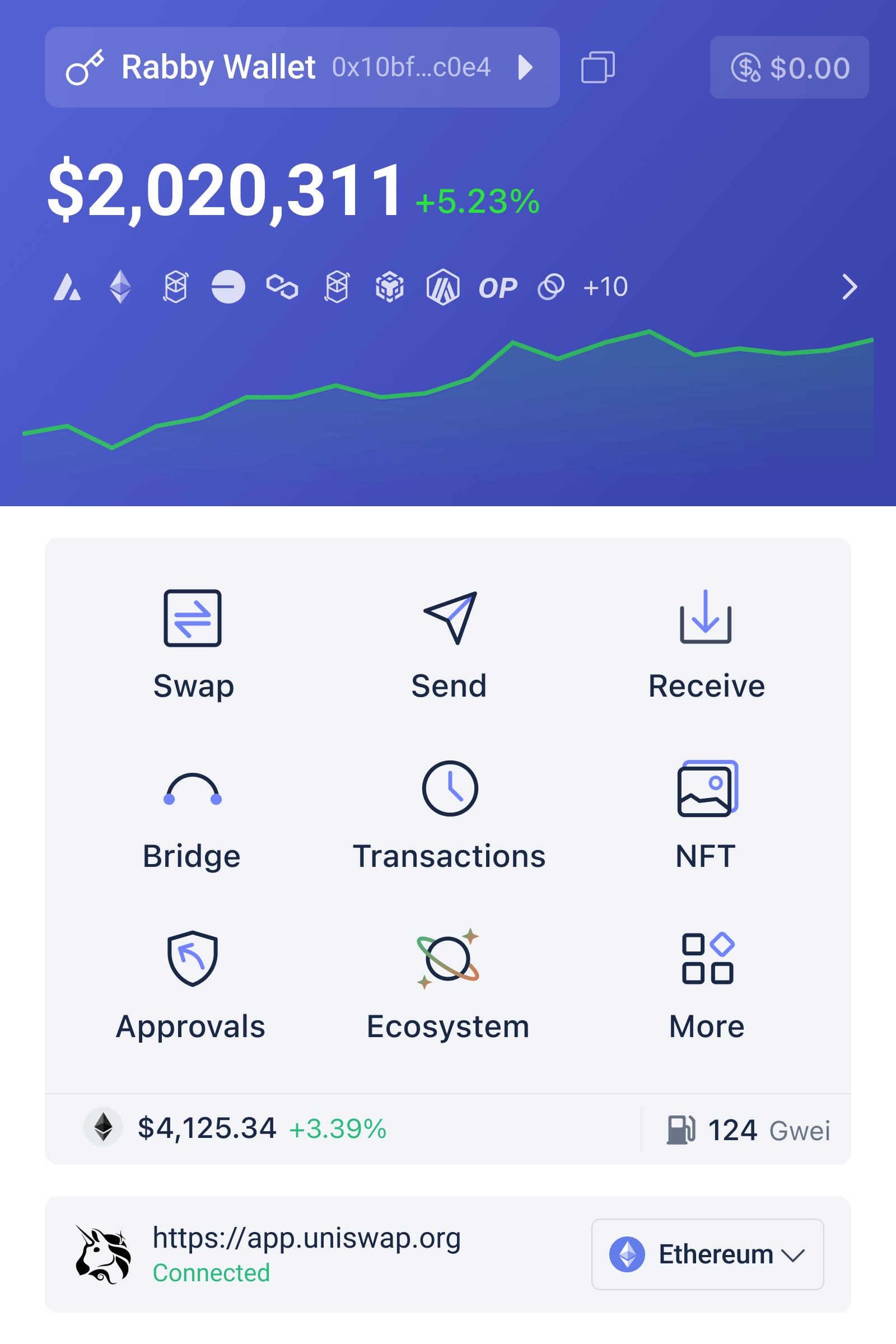
What a browser wallet actually does
Most DeFi activity begins in a browser. A user visits a decentralized exchange, lending market, bridge, staking interface, or NFT application and connects a wallet. The application then prepares a transaction or a signed message. The wallet extension receives that request, displays relevant information when available, and asks the user to approve or reject it. The blockchain does not know whether the request came from a trustworthy website. It only processes a valid signature and the resulting transaction.
This is why wallet software is best understood as an authorization layer rather than a vault in the traditional banking sense. Private keys or seed phrases control access to on-chain accounts. Whoever can use those credentials may be able to move assets, depending on the account structure and permissions involved. A browser extension can protect those credentials locally and provide a more usable signing interface, but it does not remove the underlying responsibility of key management.
Rabby’s value proposition is particularly relevant to EVM users because the same basic account model can appear across many networks. That convenience also creates a risk: an address may look familiar while the network, token contract, or application is not. A useful mental model is to treat every transaction as a bundle of claims that must be checked: who is receiving permission, what asset is involved, which chain is being used, and whether the action can be reversed.
Why installation is a security decision
Searching for a wallet extension is not a neutral first step. Fake browser extensions, impersonation pages, malicious advertisements, and copied download instructions can all be used to capture a seed phrase or redirect a user to a fraudulent interface. The most important installation rule is simple: begin from an official project channel or a carefully verified source, and inspect the publisher, permissions, domain, and browser listing before proceeding. For readers who are ready to review the official route, the rabby extension download page can serve as a starting point, but the final verification should still happen in the browser and extension store itself.
During setup, a new user will generally face two different paths: creating a new wallet or importing an existing one. Creating a new wallet means generating a new recovery phrase and protecting it offline. Importing an existing wallet means transferring control of an already important account into a new software environment. Neither path is automatically safer. A fresh wallet reduces the chance that an old phrase has already been exposed, while importing is convenient but carries forward every weakness in the original key-handling process.
A recovery phrase should never be typed into a website, sent through email, stored in a cloud document, or shared with someone claiming to provide support. A legitimate wallet workflow does not require another person to see it. Hardware wallets can reduce exposure of private keys during ordinary signing, although they do not prevent a user from approving a harmful transaction on the device. Security is layered: the extension, browser, operating system, hardware, recovery process, and human judgment all matter.
Transaction previews are useful, not magical
One of the most important security features in a modern DeFi wallet is transaction interpretation. Raw blockchain data is difficult for most people to read. A wallet may translate a contract call into a more intelligible description, show the network involved, identify assets that may be transferred, and highlight approvals or unusual interactions. This reduces the gap between what an application asks and what the user believes they are approving.
The limitation is that interpretation depends on available data and on the wallet’s ability to understand the contract. New, complex, upgradeable, or deliberately deceptive contracts can produce incomplete or misleading descriptions. A familiar token symbol can also be imitated by another contract. The right habit is therefore not “the preview looks fine, so it must be safe.” It is “the preview gives me evidence to evaluate, and uncertainty is a reason to pause.”
Token approvals illustrate the issue. When a user swaps an asset, the first transaction may grant a decentralized application permission to spend that token. The approval can sometimes cover a limited amount, but some interfaces request a very large or effectively unlimited allowance for convenience. If the approved contract is later compromised or behaves maliciously, that permission may become a route to loss. Users should distinguish between approving a protocol to spend a token and actually completing the intended swap; they are related steps, not the same event.
Signing a message deserves similar caution. Not every wallet prompt moves funds immediately. Some signatures authorize a listing, a permit, a login, or another off-chain instruction that can later be submitted by an application. A signature may have no gas fee and still carry financial consequences. Gas cost is therefore a poor proxy for risk. The more informative questions are what is being authorized, who can use the authorization, and whether it expires or can be revoked.
Using Rabby across EVM networks
The appeal of Rabby Wallet is strongest for users who move between Ethereum and other EVM-compatible chains. One extension can make network switching and account management less fragmented than maintaining separate browser tools for each ecosystem. The recent project messaging dated August 24, 2026, emphasizes support for Ethereum and EVM chains through Chrome and Brave, reflecting that broad multi-chain orientation.
Multi-chain convenience, however, can create a false sense that networks are interchangeable. They are not. A bridge may introduce smart-contract, validator, liquidity, or message-passing risk. A token with the same name may have different contract addresses on different chains. A transaction that is inexpensive on one network may be costly or congested on another. Before confirming an action, check the selected chain, the application’s expected chain, the contract address where practical, and the asset actually held there.
There is also a less obvious operational risk: address familiarity. Users often recognize the first and last characters of an address and assume they have verified it. Address-poisoning attacks exploit that shortcut by sending tiny transactions from lookalike addresses. For meaningful transfers, compare the complete address through a trusted record or use an address book whose entries were independently verified. A wallet can display the destination clearly, but it cannot determine whether a copied address belongs to the person or service intended.
A practical risk-management routine
A disciplined workflow is more reliable than trying to memorize every type of scam. Before connecting, ask whether the application is necessary and whether its domain is correct. Before signing, identify the requested action and the asset at risk. Before approving, consider whether the allowance is limited and whether the contract is one you intended to use. After interacting with a protocol, review active approvals and revoke permissions that are no longer needed, while remembering that revocation itself is an on-chain transaction with a network fee.
Separate accounts by purpose when the stakes justify it. A small experimental account can limit the damage from an unfamiliar application, while a long-term savings account can remain disconnected from routine browsing. This is not a perfect barrier: users can still transfer funds to the wrong place or sign with the wrong account. But compartmentalization changes the maximum plausible loss, which is often more useful than attempting to eliminate every risk.
For high-value transactions, use a second-person or second-device check. Read the destination aloud, compare it with a previously saved record, verify the network, and review the exact amount and token. A hardware wallet may add a separate confirmation surface, but it is not a substitute for understanding the transaction. Security tools work best when they create friction at the moments when friction is valuable.
The broader lesson is that wallet security is partly a problem of information quality. Better previews, clearer warnings, and easier network management can reduce accidental mistakes. They cannot solve protocol bugs, oracle failures, governance attacks, phishing, compromised devices, or fraudulent websites. Rabby may improve the user’s view of a transaction, but the user still decides whether the economic action makes sense.
What to watch as wallet software evolves
If multi-chain DeFi continues to expand, wallet extensions will likely compete less on basic account storage and more on interpretation, simulation, permission management, and warning quality. The useful signal will not be the number of supported chains alone. Watch whether a wallet clearly explains uncertainty, distinguishes approvals from transfers, surfaces network mismatches, and helps users recover from mistakes without implying that recovery is always possible.
For Rabby users, the conditional implication is straightforward: if transaction simulation and permission visibility become more accurate, they could reduce avoidable signing errors. If users treat those features as automatic guarantees, the same convenience could encourage faster approvals and weaker scrutiny. The outcome depends on habits as much as interface design. A polished warning that nobody reads is not a security control in practice.
Rabby Wallet Extension FAQ
Is Rabby Wallet a good choice for EVM-based DeFi?
It can be a practical choice for users who interact with Ethereum and multiple EVM networks because a browser extension can centralize account and transaction workflows. Its usefulness should be judged by the clarity of its prompts and the user’s operating discipline, not by the wallet brand alone. It does not guarantee that a connected DeFi application is safe.
Does a wallet extension protect me from scams?
It can help identify suspicious or unexpected transaction details, but protection is limited. A user may still visit a fake website, approve a genuine but dangerous contract, expose a recovery phrase, or sign a message whose consequences are poorly understood. Treat wallet warnings as risk signals and verification aids, not as an insurance policy.
Should I use one account for all DeFi activity?
Using one account is convenient, but separating long-term holdings from experimental or high-risk applications can reduce potential losses. The best arrangement depends on the user’s assets, technical confidence, and willingness to manage multiple accounts. Separation helps with containment; it does not replace checking every transaction.
What is the most important step after installing Rabby?
Establish a verification routine before connecting to applications: confirm the official website, check the network and destination, understand approvals, and protect the recovery phrase offline. Practice with a small amount before committing significant funds. The wallet is the instrument; careful authorization is the security strategy.
Rabby Wallet is best understood not as a promise that DeFi is safe, but as an interface intended to make on-chain decisions more legible. That is a meaningful improvement when users slow down and inspect what they are authorizing. The sharpest security habit is also the simplest: never let convenience answer a question that only verification can answer.